BDO Darts Playing Rules
Download PDFBased on the British Darts Organisation's Playing Rules (Section Five). The BDO itself is no longer active — the DRA's rules now govern professional play — but the BDO Playing Rules remain what most UK pub and social darts leagues play by. Clause numbers below match the original BDO document, for lookup reference.
- THROW
1.1 — Players shall provide their own darts, which shall not exceed an overall length of 30.5cm and shall not weigh more than 50 grams. Each dart shall consist of a metallic needle-shaped point attached to a barrel, with a flighted stem at the rear (which may consist of up to five separate pieces: a flight, flight securing device(s), a flight protector, and a stem).
1.2 — A player shall throw darts from a standing position, except where a physical disability or injury requires a non-standing position.
1.3— All darts shall be thrown deliberately, one at a time, by and from the hand, with the needlepoint aimed towards the face of the dartboard. If a dart is not thrown in this manner the throw is a 'foul throw' and does not count in that leg, set, or match.
1.4 — A throw consists of a maximum of three darts, unless the leg, set, or match is completed in fewer.
1.5 — If a player touches any dart already in the dartboard during a throw, that throw is deemed complete.
1.6 — Any dart bouncing off or falling out of the dartboard shall not be re-thrown.
1.7 — Any dart falling out of the dartboard before the throw is completed and the darts retrieved does not count.
1.8 — It is NOT permissible, prior to retrieval, for a player or scorekeeper to push a dart into the board to prevent it falling out, or to hold it in the board for the same reason — any dart affected does not count.
1.9 — A player deliberately abusing the dartboard when retrieving darts receives a verbal warning; a second incident in the same match draws another warning; a third incident forfeits that leg, set, or match.
- STARTING AND FINISHING
2.1— Unless the event's playing format states otherwise, each match or leg is played with a straight start — to begin scoring, the player need only land a dart in the dartboard inside the outer doubles wire.
2.2 — Unless stated otherwise, each match or leg is played with a double finish — to finish and win, the player must land a dart in the double (double ring or bull) of the number equal to one half of the remaining score.
2.3— The Bull shall count as '50' if the score of '50' is required to complete a leg or match.
2.4— The Bull shall count as double '25'.
2.5 — The Bust Rule applies: if a throw scores more points than remain, or the same points as remain without finishing on a double, or leaves a score of one, then that throw does not count and the score reverts to what it was before the throw.
2.6— A 'Game Shot' called by a Caller is valid only if the darts thrown achieve the required finish and remain in the board until retrieved after the call.
2.7 — If a Game Shot call is invalid, the player may continue the throw (if not all three darts have been thrown).
2.8 — If darts have already been retrieved in error before all three were thrown, the Referee replaces the retrieved dart(s) as near as practicable to their original position and lets the player complete the throw.
2.9 — The first player to obtain the required double out is the winner of that leg or match. A dart thrown after finishing does not count.
2.10— A match or set divided into legs is played 'best of three' (five, seven, etc.) legs — the first player to win a majority of the given number of legs wins, and the remaining legs are not played.
2.11— A match divided into sets is played 'best of three' (five, seven, etc.) sets — the first player to win a majority of the given number of sets wins the match, and the remaining sets are not played.
- SCORING
3.1 — Matches or legs start from a fixed odd number such as 501, 701, or 1001. All scores are subtracted from the starting total or from the score remaining after the previous throw.
3.2 — The score required by each player is shown on the score sheet or visual display.
3.3 — A dart only scores if its point remains in or touches the face of the board, within the outer double wire, until after the throw is complete and the score has been called and recorded.
3.4 — The score is counted from the side of the segment wire the point enters and remains touching.
3.5 — Darts are retrieved by the thrower (except where disability/injury requires assistance), and only after the score has been recorded by the Marker.
3.6 — Protests about a recorded score cannot be made once the score is recorded and the darts retrieved; if an incorrect score resulted in a leg win, the result stands.
3.7 — Arithmetic errors stand as written on the scoreboard unless corrected before the next throw of the player whose score is in error.
3.8 — The required score must be shown on the scoreboard or visual display and be clearly visible, at eye level, in front of the players and the Board Marker.
3.9— No indication of the required double shall be given by the Referee, Caller, Marker, or Scorer — e.g. '32' is called, not 'double 16'.
3.10 — The Board Marker acts as umpire in all matters pertaining to the Playing Rules, consulting Tournament Officials where necessary before announcing decisions.
- DARTBOARDS — APPROVED SPECIFICATION
4.1 — Dartboards must be of the bristle type, manufactured from sisal, with a 1–20 clock pattern. The inner centre ring (bull) scores 50 points, the outer centre ring scores 25. The inner narrow band (treble ring) scores treble the segment number; the outer narrow band (double ring) scores double the segment number.
- Wire types: round, triangular, or diamond-shaped in section, 1.27–1.85mm (±0.2mm).
- Double/treble width: 8.0mm ±0.2mm (wire boards, inside-to-inside) or 10.0mm ±0.2mm (strip material, apex-to-apex).
- Inner bull (50) ring inside diameter: 12.7mm ±0.2mm. Outer bull (25) ring inside diameter: 31.8mm ±0.3mm.
- Outside edge of double wire to centre bull: 170.0mm ±0.2mm. Outside edge of treble wire to centre bull: 107.4mm ±0.2mm.
- Outside edge of double wire, diameter: 340.0mm ±0.5mm. Overall dartboard diameter: 451.0mm ±3.0mm.
4.2— The board is fixed so the '20' segment is the darker of the two segment colours and sits at the top centre of the board.
4.3 — A player or team official may request the board be changed or turned before or during a match, provided the opponent concurs — such a change may only be made before a match or between legs, and only by a Tournament official.
- LIGHTING
5.1 — In tournament play, each floor dartboard shall be adequately lit by a suitably positioned light fitting of at least 1600 lm (100W).
5.2 — Dartboards used in stage finals shall be adequately lit by at least two such fittings.
5.3— All light fittings shall be fitted with screens to divert light away from the player's eyes when standing at the oche.
5.4 — In staged finals, illumination may be augmented with flood or spot lights, taking care to avoid shadows on the board during match play.
- BOARD SETUP AND OCHE DIMENSIONS
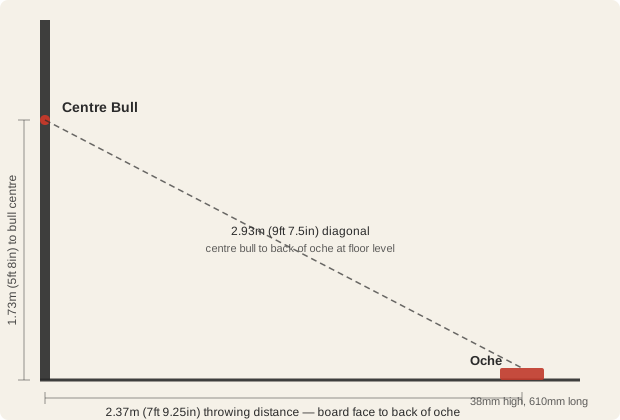
6.1 — The dartboard is fixed such that the vertical height from the floor (at the level of the oche) to the centre of the bull measures 1.73m (5ft 8in).
6.2 — A raised oche, 38mm high and 610mm long (1.5in high, 24in long), is placed at the minimum throwing distance, measuring 2.37m (7ft 9.25in) from the back of the oche along a horizontal line to a plumb line at the face of the board.
6.3 — The diagonal distance from the centre of the bull to the back of the oche at floor level measures 2.93m (9ft 7.5in).
6.4 — The minimum depth of the standing area behind the oche shall be not less than 1.22m (4ft 0in) of clear space.
6.5 — During match play, no player may tread on any part of the raised oche, nor deliver any dart with their feet in any position other than behind the raised oche.
6.6 — A player throwing from a position on either side of the raised oche shall keep their feet behind an imaginary straight line extending on either side of the oche.
6.7— Any player in breach of clause 6.4 or 6.5 shall first be warned by the Referee in the presence of the player's Captain or team official. Any dart subsequently delivered in breach of these clauses shall not score and shall be declared invalid by the Referee.
6.8 — A player or team official may request the oche dimensions be checked and adjusted before or during a match, provided the opponent concurs — such a check may only be made before a match or between legs, and only by a BDO-appointed official.
6.9 — Member Darts Bodies are authorised to amend the dimensions of the dartboard height and oche length to suit the particular requirements of contestants in special events for disabled persons.